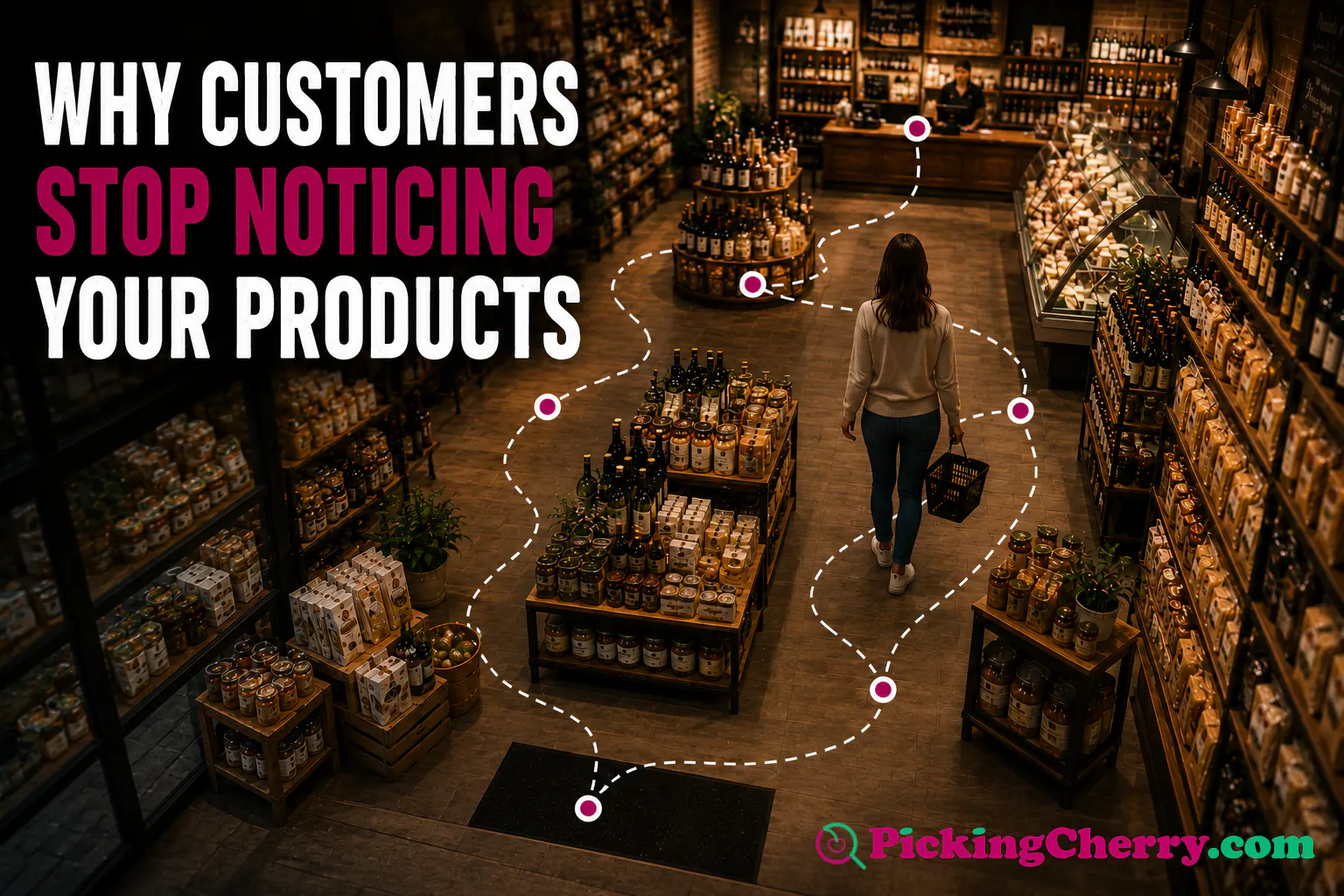
Why Customers Stop Noticing Your Products
One of the biggest misconceptions in retail is believing that customers see everything inside a shop. In reality, they don’t.
The longer people shop in the same place, the more selective their attention becomes. Regular customers often walk past dozens of products without consciously noticing them, not because those products have become less interesting, but because they have become familiar. This is a completely natural behaviour.
The first time someone visits a delicatessen or speciality food shop, they usually spend time exploring. They browse different categories, compare products, read labels and often leave with something they had never planned to buy. Curiosity slows them down and encourages discovery.
A few visits later, the experience changes. Customers already know where to find their favourite pasta, olive oil, coffee or wine, so they naturally follow the same route every time they visit. Shopping becomes quicker, easier and more efficient, which is exactly what every retailer wants. The downside is that familiarity gradually reduces discovery, and products that once attracted attention slowly become part of the background even though nothing about them has actually changed.
Understanding this behaviour is one of the foundations of effective retail management. It also explains why successful retailers regularly review their assortment instead of assuming that the same product mix will remain effective forever. Why Great Food Businesses Keep Changing Their Assortment
Familiarity Creates Loyalty… and Blind Spots
Consistency is one of the reasons customers return.
People appreciate finding the products they buy regularly in the same place because it saves time, reduces frustration and makes shopping more comfortable. Very few customers enjoy entering a shop only to discover that the products they buy every week have been moved somewhere completely different.
For this reason, consistency should never be underestimated. At the same time, it creates an unintended consequence. As customers become more familiar with a shop, they stop actively looking at much of the assortment. Their brain filters information it already knows and focuses almost entirely on the products they intended to buy before they even walked through the door.
This explains why excellent products sometimes remain unnoticed despite being permanently available. The issue is often not the product itself, but the fact that customers have simply stopped seeing it.
Customer Behaviour Tells You More Than Sales Reports
When sales decline, retailers often start by questioning the product. Perhaps the price is wrong, perhaps a competitor has introduced a better alternative, or perhaps customer tastes have changed. Sometimes those explanations are correct. Quite often, however, the product is not the problem at all.
Retailers can spend hours analysing reports and KPIs, yet learn very little about how customers actually behave inside the shop. Spending time on the shop floor often provides insights that no spreadsheet can reveal. It quickly becomes obvious which displays naturally attract attention, which areas customers rarely visit and which products have effectively disappeared from view despite still occupying exactly the same shelf.
Two products with similar sales figures may have completely different stories behind them. One may be actively chosen because customers compare it with competing products every day, while another simply benefits from being positioned along the natural route most shoppers follow. Understanding the difference helps retailers improve visibility before assuming that the product itself needs to change.
Discovery Doesn’t Always Require New Products
Many businesses believe they need a constant flow of new products to maintain customer interest. New products certainly have their place, but they are only one way of encouraging discovery.
As discussed in our article Why Great Food Businesses Keep Changing Their Assortment, introducing new products remains essential, particularly when customer preferences, seasonality or the competitive environment evolve. However, businesses often overlook another opportunity: helping customers rediscover products that are already part of the assortment.
Customers often rediscover products that have been available for years when they are presented in a different context. A regional food theme may encourage customers to explore products they had previously ignored, a seasonal display can completely change the perception of familiar products, while tastings, recipe suggestions or simple recommendations from knowledgeable staff often introduce customers to products they have walked past dozens of times without ever considering.
Nothing about the product has changed. The customer’s attention has.
The First Few Steps Rarely Sell Products
Retail professionals often refer to the three-step rule, a simple way of explaining what happens immediately after a customer enters a shop. During those first few steps, people are not really shopping yet. They are slowing down, adjusting to the new environment and unconsciously deciding where to go first. This area is more commonly known as the decompression zone and, although its exact size varies from one business to another, the principle remains remarkably consistent.
For this reason, the first metres inside a shop are rarely the best location for products that require customers to stop, compare or make purchasing decisions. Their value lies elsewhere.
Many retailers place shopping baskets close to the entrance because customers often realise they need one only after taking a few steps inside. They naturally turn back, collect a basket and continue shopping. In this case, the entrance is supporting the shopping journey rather than trying to generate immediate sales.
There are, of course, exceptions. A promoter offering samples, a striking seasonal installation or another strong visual stimulus can successfully interrupt the customer’s natural behaviour, but these situations work precisely because they stand out from the surrounding environment rather than relying on it.
The way products are positioned throughout a shop deserves a much deeper discussion than a single section can provide, and we will explore this topic in a future article dedicated entirely to product placement in food retail.
Visibility Is About Opportunity, Not Constant Movement
One of the biggest misconceptions in merchandising is that improving visibility simply means moving products to a different shelf. In practice, constantly changing the layout often creates more frustration than additional sales. Loyal customers expect everyday products to remain easy to find, and repeatedly moving them forces people to search for items they buy every week.
Successful retailers usually take a different approach. Core products remain in familiar locations while opportunities for discovery are created elsewhere. A seasonal product can stay in its usual position while also appearing on a promotional display, regional specialities can be grouped together to tell the story of a particular Italian region, while new arrivals may receive additional exposure through end caps, countertop displays, checkout areas or dedicated promotional stands.
Customers continue finding the products they expect exactly where they left them while simultaneously discovering products they might never have noticed otherwise. Good merchandising is not about constantly changing everything; it is about deciding what deserves greater attention at a particular moment.
Retail Insight
Increasing visibility does not necessarily require moving a product. In many cases, creating a secondary display is far more effective than disrupting the customer’s usual shopping route.
Not Every Product Has the Same Job
Retailers sometimes talk about products as though they all serve the same purpose. They don’t.
Some products generate regular traffic because customers actively come looking for them. Others deliver stronger margins, reinforce the identity of the business or introduce customers to categories they might never have explored before. Seasonal products deserve greater visibility when demand is approaching, promotional lines need immediate attention and excess stock may temporarily require additional exposure.
Treating every product in exactly the same way usually means missing commercial opportunities. Good merchandising is ultimately about understanding the role each product plays and deciding where it deserves the greatest visibility.
Independent Businesses Have a Competitive Advantage
Large supermarket chains have enormous buying power, but they also operate within highly structured systems. Store layouts, category plans and national promotions are often decided months in advance, leaving relatively little flexibility at store level.
Independent food businesses work differently. Their greatest advantage is not simply being smaller, but being able to make decisions quickly, observe the results and adapt again if necessary. This flexibility is one of the main reasons independent retailers can compete successfully without trying to imitate supermarkets. How Independent Food Businesses Compete with Supermarkets
They can react to customer behaviour almost immediately, create seasonal displays in a single afternoon, organise tastings, explain unfamiliar products and respond to local opportunities without waiting for head office approval. Helping customers understand when, how and why to enjoy unfamiliar products is often just as important as importing them in the first place, a subject we will explore in a future article about Importing Products Doesn’t Import Their Culture.
That flexibility is difficult for larger retailers to replicate and, when used well, becomes a genuine competitive advantage.
Great Retailers Guide Attention
Customers rarely stop buying good products because those products suddenly become less appealing. More often, they simply stop noticing them.
Helping customers rediscover products does not require endless store refits or a constant stream of new product launches. It requires understanding how people naturally shop and making thoughtful adjustments that encourage curiosity without making shopping less convenient.
The most successful retailers understand that merchandising is not decoration; it is communication. Every display, every promotional area and every carefully chosen product location sends a message about what deserves the customer’s attention at that particular moment.
Businesses that understand this rarely leave discovery to chance. They create an environment where customers can easily find what they came to buy while still leaving with something they had not expected to discover.
 £
£  €
€