
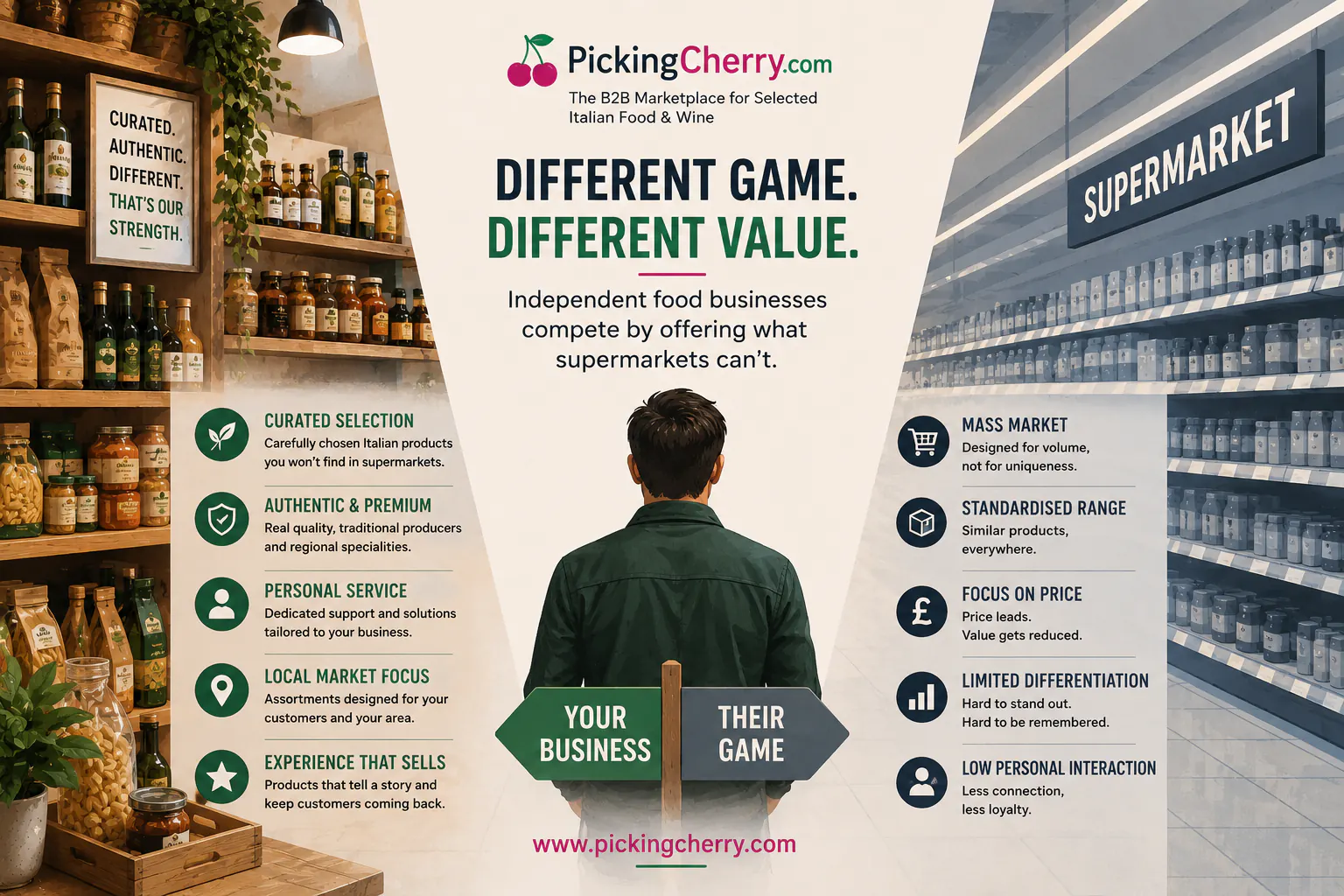
How Independent Food Businesses Compete with Supermarkets
Independent food businesses are operating in a market that has changed dramatically over the last decade.
Supermarkets no longer offer only basic products and generic assortments. Many now invest heavily in premium ranges, international food selections, private labels designed to imitate delicatessens, and imported products that were once found almost exclusively in specialist shops.
Italian food is one of the clearest examples of this evolution.
Today, customers can buy pasta, olive oil, preserves, sauces, biscuits, wine, truffle products, and regional Italian specialities almost everywhere — from supermarkets and online marketplaces to cash & carry suppliers and discount retailers.
For independent restaurants, delicatessens, cafés, wine bars, and food retailers, this creates an important challenge.
Competing directly with supermarkets on price, convenience, product volume, or purchasing power is extremely difficult. Large retail chains benefit from economies of scale, aggressive pricing strategies, national distribution systems, and supplier leverage that independent businesses simply cannot match.
However, this does not mean that independent businesses cannot compete successfully. They simply need to play a different game.
Independent Businesses Must Offer Something Different
Many independent food businesses make the mistake of trying to compete with supermarkets using very similar assortments.
This often happens because the same products are repeatedly sourced through the same import channels and generic supplier catalogues.
As a result, many independent shops gradually begin to look increasingly similar to supermarkets, while still operating with higher costs and lower purchasing power.
Independent businesses that offer the same assortments as supermarkets often become difficult to distinguish from them. When customers can buy identical products everywhere, price naturally becomes the main comparison point.
This creates pressure on margins, reduces differentiation, and makes it harder to build customer loyalty or create a memorable identity. For many businesses, the challenge is no longer simply finding Italian food products.
The challenge is offering products, selections, and experiences that customers cannot easily find elsewhere.
The Evolution of Italian Food in the UK
Italian food remains one of the most appreciated cuisines in the UK, but customer expectations have evolved significantly. Consumers travel more, discover regional food cultures abroad, visit local producers, try authentic products during holidays, and become familiar with foods that were once almost unknown outside Italy.
Many customers now recognise the difference between generic industrial products and Italian products with stronger regional identity, more distinctive flavours, traditional production methods, or higher perceived quality.
Supermarkets themselves have contributed enormously to the popularity of Italian food in the UK. However, supermarket assortments are usually built around mass-market products, high-volume lines, and standardised selections designed to work nationally across thousands of stores.
Only very large supermarkets can dedicate significant space to broader international assortments, while most stores still offer relatively limited selections that rarely reflect the real diversity of Italian food culture and regional specialities.
In many cases, product uniqueness, authenticity, and customer guidance become secondary compared to pricing strategies and operational simplicity.
This creates opportunities for independent food businesses that can offer more curated selections, stronger product identity, and a more personalised customer experience.
Product Selection Has Become a Competitive Advantage
For independent food businesses, product selection is no longer only a purchasing decision. It has become part of branding, positioning, and customer experience. A carefully selected range can completely change how customers perceive a business.
The right products can help:
- improve perceived quality
- support premium pricing
- create stronger differentiation
- increase customer loyalty
- strengthen the atmosphere and personality of a shop or restaurant
- encourage discovery and repeat visits
A delicatessen offering the same products available in every supermarket may struggle to justify higher pricing or create strong customer engagement.
On the other hand, a more curated assortment of regional Italian specialities, premium pantry products, distinctive brands, or less common product lines can immediately change customer perception and create a more memorable experience.
For restaurants and wine bars, product selection also supports storytelling, menu identity, and atmosphere.
For cafés and independent retailers, carefully chosen products can transform simple purchases into reasons for customers to return and recommend the business to others.
Understanding the Local Market Matters
Product, brand, and category selection should always reflect the local market surrounding a business. Different areas often have different customer profiles, habits, cultural backgrounds, purchasing behaviours, and expectations.
Understanding the competitive environment helps businesses identify opportunities to create more distinctive assortments rather than simply replicating nearby competitors.
Introducing new products periodically can also be an effective way to attract attention, increase engagement, and encourage customers to return more frequently. Regional specialities, seasonal products, limited selections, or less common brands can create curiosity and prevent the offer from becoming predictable.
A business located in an area with international customers, food enthusiasts, or communities already familiar with Italian food culture may benefit from a wider and more specialised assortment. The objective is not only attracting new customers, but also encouraging existing customers to explore additional categories and expand the range of products they purchase.
A stronger and more carefully targeted product selection can therefore increase both customer loyalty and footfall while helping a business develop a more recognisable identity.
Beyond Price Competition
Independent food businesses rarely compete successfully by trying to behave like supermarkets. Their real advantage comes from offering something supermarkets cannot easily replicate: selection, identity, flexibility, customer interaction, and more distinctive experiences.
This does not necessarily mean focusing only on niche artisanal products. Reliability, consistency, logistics, shelf life, commercial structure, and product availability remain extremely important for the UK market.
The real opportunity comes from selecting products that combine commercial value with stronger identity and differentiation potential. Many Italian products remain underrepresented in the UK despite having strong reputation, quality, and commercial potential in Italy.
For independent businesses, these products can help create a more distinctive offer without relying entirely on price competition. In today’s market, customers remember businesses that offer products and experiences they cannot easily find elsewhere. This is where independent food businesses can still create a real competitive advantage.
 £
£  €
€