
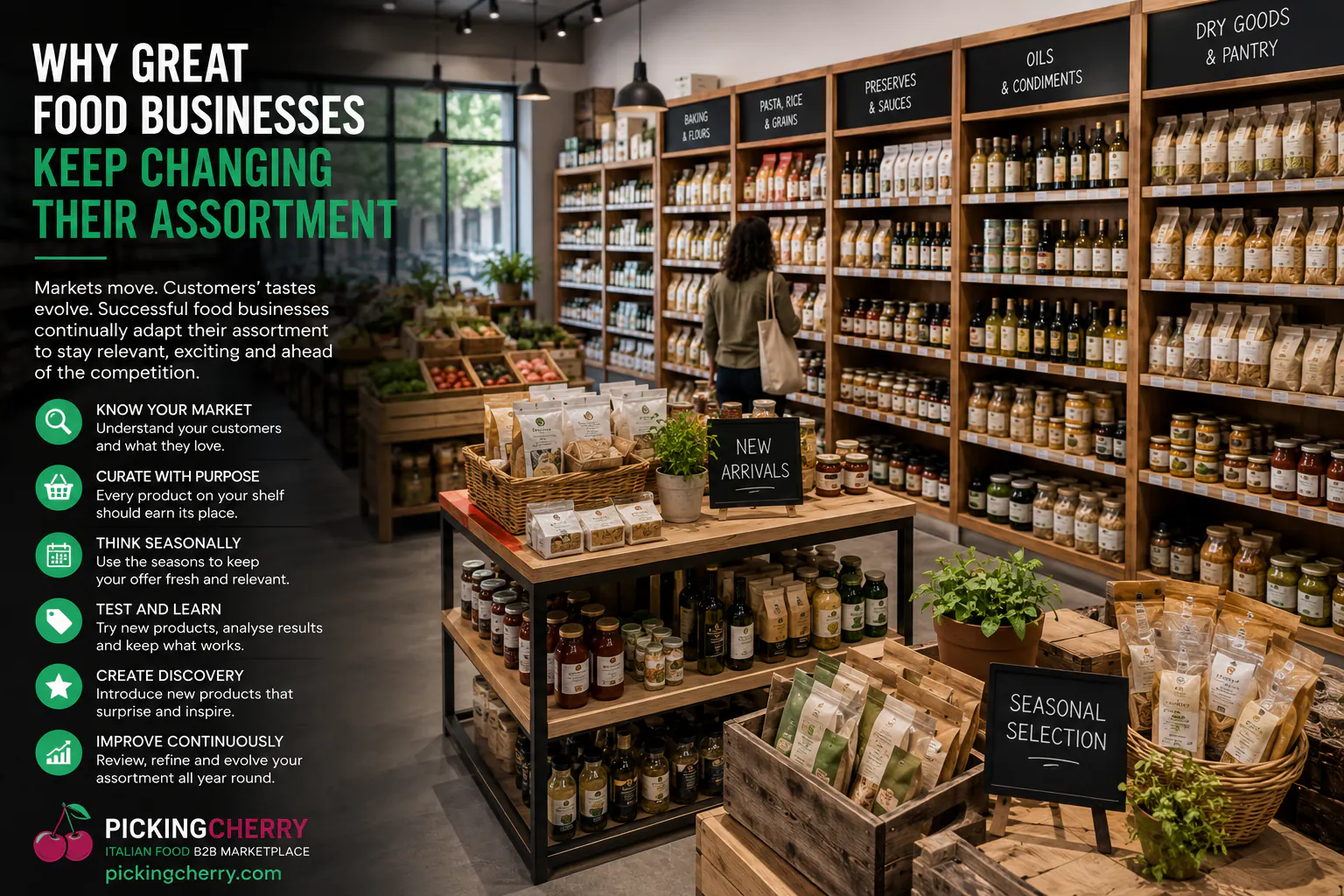
Food Business Assortment Strategy: Why Food Business Assortment Should Never Stand Still
Walk into a successful independent food shop today and come back six months later. The business will probably feel familiar, but it will not be exactly the same.
You may notice a new regional speciality on display, a different wine selection, a seasonal promotion, or products you had never seen before. At the same time, many of the core lines will still be there.
That balance is rarely accidental.
The strongest food businesses understand that an assortment is never something to complete and forget. It is one of the most important commercial tools they have, and it needs continuous attention.
An Assortment Should Reflect the Business
Every product tells customers something. It communicates quality, positioning, price level, personality, and even the type of customer the business wants to attract.
This is why building an assortment is far more than selecting products from a supplier catalogue. A carefully chosen range helps create an identity that customers recognise and remember.
Adding products simply because they are available often has the opposite effect. Shelves become crowded, categories lose focus, and customers find it harder to understand what makes the business different.
Customer Behaviour Never Stands Still
One of the biggest mistakes retailers make is assuming that customers always shop in the same way. They don’t. People become familiar with what they see regularly.
Products that once attracted attention gradually become part of the background, especially for loyal customers who visit frequently.
This is one of the reasons why introducing new products matters. A seasonal speciality, a different producer, or a regional Italian product can encourage customers to slow down, look around, and discover something they would otherwise have walked straight past.
Sometimes, changing only a small part of the assortment is enough to make the entire shop feel new again.
Bigger Doesn’t Always Mean Better
Many businesses measure the quality of an assortment by the number of products they offer. Customers rarely do.
A catalogue with hundreds of similar products can be more confusing than helpful. Successful retailers focus on relevance rather than quantity. Shelf space is limited, and every product should justify the space it occupies.
Some products generate volume, others improve margins, some strengthen the image of the business, and others attract customers who then purchase additional products.
Not every item needs to become a bestseller to deserve its place on the shelf.
Great Retailers Test, Observe and Adapt
No business owner can predict every successful product. That is why testing should become part of everyday retail management.
Launching a new product in limited quantities reduces risk while providing valuable information about customer preferences.
Some products become permanent additions. Others work only during specific seasons.
Some appeal to a particular customer group that the business had previously overlooked. Even unsuccessful products are useful because they provide data that helps improve future decisions.
Retail is built on observation just as much as intuition.
Every Local Market Is Different
Understanding the local community is just as important as understanding the products themselves. A neighbourhood full of young professionals will often have different expectations from an area with established families or a strong international community.
Competitors also influence purchasing decisions. However, studying competitors should never mean copying them.
If every nearby shop offers exactly the same products, another identical assortment simply gives customers one more place to buy the same things.
Local communities also evolve over time, making regular reviews of the assortment just as important as the initial product selection.
The opportunity often lies in offering something they cannot easily find elsewhere.
Seasonality Is More Than Christmas
Many businesses think about seasonality only at Christmas or Easter. In reality, customer behaviour changes throughout the year.
Fresh truffles, chestnuts, mushrooms, artisan panettone, gelato, soft drinks, wines, fresh produce, and many regional Italian specialities all have their own periods of stronger demand.
Summer brings different purchasing habits from winter. Customers often look for lighter meals, refreshing drinks, products requiring little preparation, and ingredients suitable for outdoor dining.
As temperatures fall, preferences naturally move towards richer flavours, comfort food, fuller-bodied wines, and ingredients associated with slower cooking.
Successful retailers do not simply react to these changes. They prepare for them.
A Product Is Only Part of the Story
Having the right products is important. Presenting them well is equally important. A seasonal product hidden on the bottom shelf rarely performs as well as one displayed where customers immediately notice it.
The same applies to promotions, new arrivals, regional themes, tasting events, and complementary products displayed together.
Good merchandising helps customers discover products they did not know they wanted. This is a subject worth exploring in its own right because product placement can influence sales just as much as product selection.
Sometimes Demand Needs To Be Created
Customers cannot ask for products they have never discovered. Many Italian products remain relatively unknown outside Italy, not because they lack quality, but because consumers have never had the opportunity to experience them.
Independent food businesses have an important advantage over larger retailers.
They can explain products, organise tastings, recommend pairings. They can tell the story behind regional specialities and introduce customers to new traditions.
Importing a product does not automatically import its culture. Helping customers discover when, how, and why to enjoy it is often just as important as placing it on the shelf.
Retail Is Never Finished
Successful food businesses never assume that a good assortment will remain successful forever. They regularly review sales performance, monitor fast and slow sellers, test new ideas, refine merchandising, and adapt their offer as customer behaviour and seasons change.
Most importantly, they never assume that today’s successful assortment will automatically remain successful tomorrow.
The businesses that continue evolving are often the ones customers continue returning to.
Related insights
Coming soon
- The Power of Product Placement in Food Retail
- Why Customers Stop Noticing Your Products
- Seasonality Is More Than Christmas
- Importing Products Doesn’t Import Their Culture
- Every Product Should Earn Its Shelf Space
 £
£  €
€