
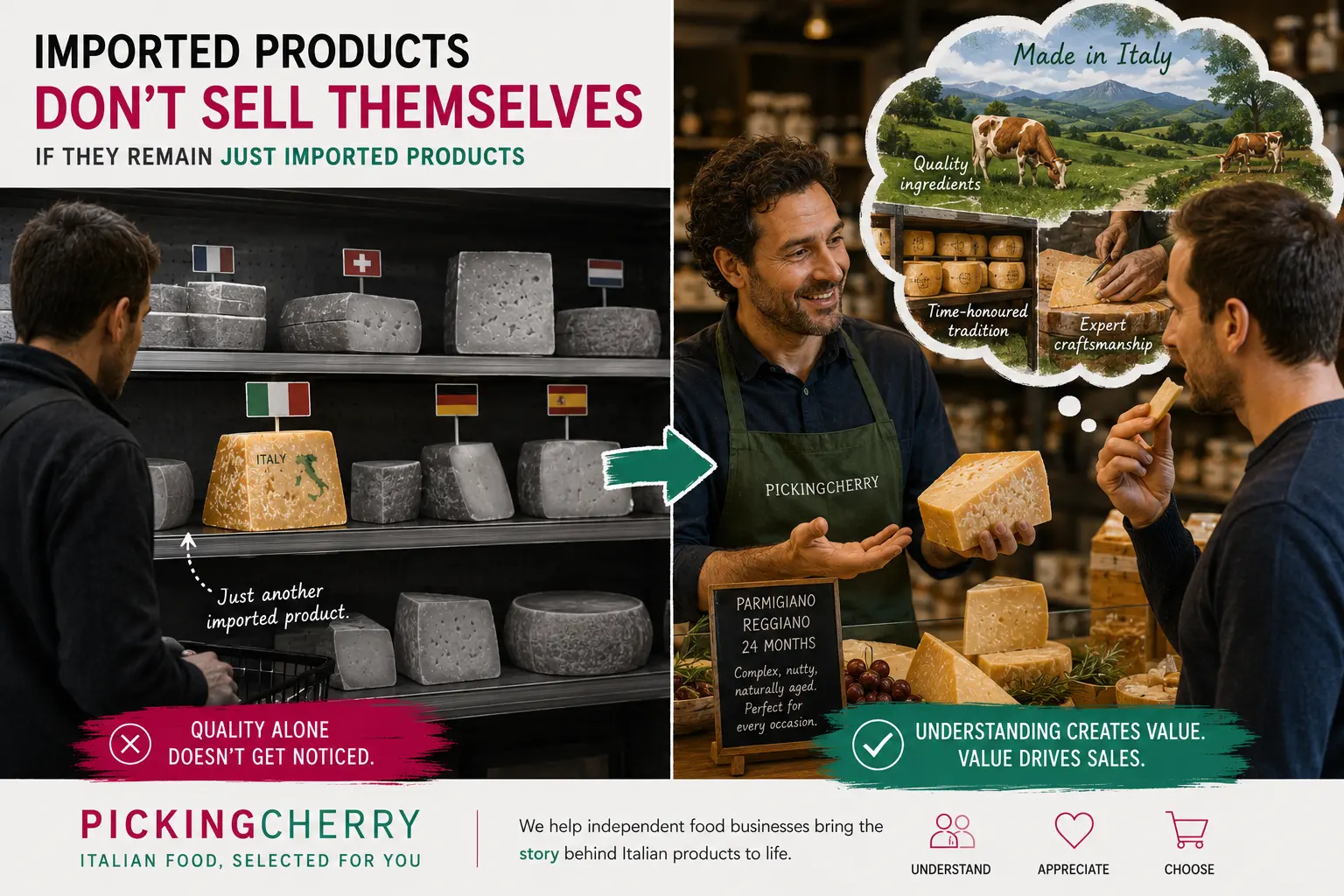
Imported Products Don’t Sell Themselves If They Remain Just Imported Products
When businesses decide to expand their assortment with imported products, most of their effort goes into finding the right suppliers. They compare quality, negotiate prices, organise logistics and carefully select products that can help them stand out from competitors. By the time the first delivery arrives, it’s easy to believe that the hard work is over.
Most businesses stop there. They assume that once the products have arrived, their quality will do the rest. That’s where many imported products begin to struggle.
Selecting exceptional products is only half the job. The other half is helping customers recognise why they’re exceptional.
Many imported products reach the shelf exactly as they left the producer: authentic, carefully made and often unavailable anywhere else locally. Yet authenticity alone rarely creates demand. Customers don’t buy a product simply because it comes from Italy, Spain or France, or because someone describes it as artisan. They buy it when they understand what makes it worth choosing over everything else beside it.
Quality Doesn’t Sell. Recognised Quality Does.
There is an important distinction between quality and perceived value.
Quality exists whether customers recognise it or not. A cheese can be matured for thirty months, an olive oil can come from centuries-old trees and a cured meat can still be produced using methods refined over generations. None of those qualities disappear simply because customers don’t know they exist.
The problem isn’t quality, it’s invisible quality. If customers can’t recognise it, they can’t appreciate it, and if they can’t appreciate it, they’re unlikely to pay more for it.
Perceived value isn’t created through clever marketing or exaggerated claims. It is built by helping customers understand what they’re looking at. Why is this product different? Why does it cost more? What makes its flavour unique? How should it be enjoyed? Why has it earned its reputation?
Businesses often spend months selecting products but only a few seconds explaining them.
That imbalance explains why so many outstanding imported products fail to achieve the success they deserve.
Customers Need a Reason to Choose Something Unfamiliar
Food is deeply connected to habit. Most people naturally buy products they already know because familiarity reduces uncertainty. They know what to expect, how to cook them and whether the people sitting around their table are likely to enjoy them.
An unfamiliar imported product asks customers to step outside that comfort zone. Fortunately, the step is much smaller when they’re given a good reason to take it.
That reason can take many forms. It may be the opportunity to taste the product before buying it, the curiosity of trying something new, the recommendation of a knowledgeable retailer or waiter, or simply understanding where the product comes from and why generations of producers have continued making it in the same way.
Customers rarely buy an unfamiliar product because they were already looking for it. They buy it because someone gave them a reason to try it.
People don’t buy imported food because it crossed a border. They buy it because they understand why it deserves a place on their table.
The Story Doesn’t Replace Quality. It Explains It.
Storytelling has become one of the most overused words in food marketing. Too often, it turns into long romantic descriptions that sound appealing but do very little to help customers make a purchasing decision.
The purpose of telling a product’s story isn’t to make it sound poetic. It’s to explain why that product deserves its reputation.
Take Parmigiano Reggiano as an example. Without any context, many customers simply see an expensive hard cheese sitting next to cheaper alternatives. If that’s all they know, comparing prices is perfectly reasonable.
Now imagine they discover that it can only be produced within a protected geographical area, that every wheel must follow strict production rules, that it’s matured for at least twenty-four months and that its versatility extends far beyond grating it over pasta.
They’re no longer comparing two hard cheeses. They’re comparing two completely different products.
The story hasn’t increased the product’s quality. It has simply revealed it.
The same principle applies to olive oils, balsamic vinegar, regional wines, cured meats, preserves and hundreds of other speciality products. Behind each one are people, traditions, local ingredients, production methods and generations of experience that explain why the product exists in its current form.
Those aren’t marketing details, they’re part of the product’s value. Ignoring them means leaving part of the product behind.
Turning Curiosity into Confidence
Every imported product faces the same challenge: customers don’t have a relationship with it yet. Many businesses expect curiosity to do most of the work. If a product looks authentic or unusual enough, people will naturally want to try it.
Occasionally they do. More often, they don’t. Curiosity may persuade someone to stop in front of a shelf, but confidence is what persuades them to put a product into their basket.
That’s why businesses that successfully introduce speciality food rarely rely on the product alone. They make it easier for customers to understand what they’re buying.
A tasting removes uncertainty because people experience the flavour before making a decision. A simple serving suggestion answers the question, “What would I actually do with this?” A recommendation from someone knowledgeable replaces hesitation with confidence.
None of these things changes the product itself. They simply remove the uncertainty surrounding it.
Many of today’s best-selling speciality products were once completely unknown outside their region of origin. They didn’t become successful because customers happened to discover them by chance. They became successful because someone invested time in introducing them properly.
Independent Businesses Have an Advantage
This is one of the reasons independent food businesses still have a significant advantage over supermarkets. We’ve explored this competitive advantage in greater detail in our article How Independent Food Businesses Compete with Supermarkets.
Large retailers benefit from scale, buying power and aggressive pricing, but they struggle to create the personal interaction that often makes speciality food approachable.
A supermarket shelf cannot explain why one extra virgin olive oil has a peppery finish while another tastes softer and fruitier. It cannot explain why two balsamic vinegars with similar labels have completely different production methods. Nor can it explain why a small family producer has chosen to preserve techniques that have remained virtually unchanged for generations. People can.
An independent retailer can recommend a product based on a customer’s tastes. A delicatessen owner can suggest the perfect cheese for a particular occasion. A waiter can explain why a regional cured meat is served in a certain way or recommend the wine that brings out its best characteristics.
Those conversations do something price labels never can. They reduce uncertainty. And once uncertainty disappears, customers become far more willing to explore something unfamiliar.
Selling the Product Means Selling the Understanding
People rarely remember buying another bottle of olive oil, they remember discovering one that completely changed the way they thought about something as simple as bread.
They don’t remember buying another cheese, they remember serving it to friends, talking about where it came from and watching everyone’s reaction after the first taste.
The memory isn’t created by the purchase. It’s created by the understanding that came before it.
This is why education should never be seen as an optional extra for businesses selling speciality food. Helping customers understand a product isn’t separate from selling it. It is part of the sale itself.
The objective isn’t to overwhelm people with technical information or romantic stories. It’s simply to give them enough knowledge to appreciate what makes that product different.
Once that happens, customers stop comparing it only on price. They begin comparing it on value.
Beyond the Product
Businesses often talk about differentiation as if it depended entirely on finding products that competitors don’t stock. In reality, differentiation begins much earlier.
Imagine two independent food shops selling exactly the same products from exactly the same producer. One simply places them on the shelf with a price tag. The other explains where they come from, why they taste the way they do, how they should be served and which customers usually enjoy them most. The products are identical, the customer experience isn’t.
That’s the difference between stocking imported products and building a reputation for offering them.
Selecting exceptional products is only half the job. Helping customers recognise their value is the other half.
The objective isn’t to create value where none exists. It’s to make existing value visible. When that happens, imported products stop competing simply because they’re different. They begin succeeding because customers understand why they’re worth choosing.
Products can cross borders in a matter of days. Their value only crosses those borders when someone takes the time to explain it.
At PickingCherry, we believe sourcing exceptional products is only the beginning. Our role is to help independent food businesses recognise their value, so their customers can recognise it too.
Exceptional products deserve more than a place on a shelf. They deserve to be understood.
 £
£  €
€