
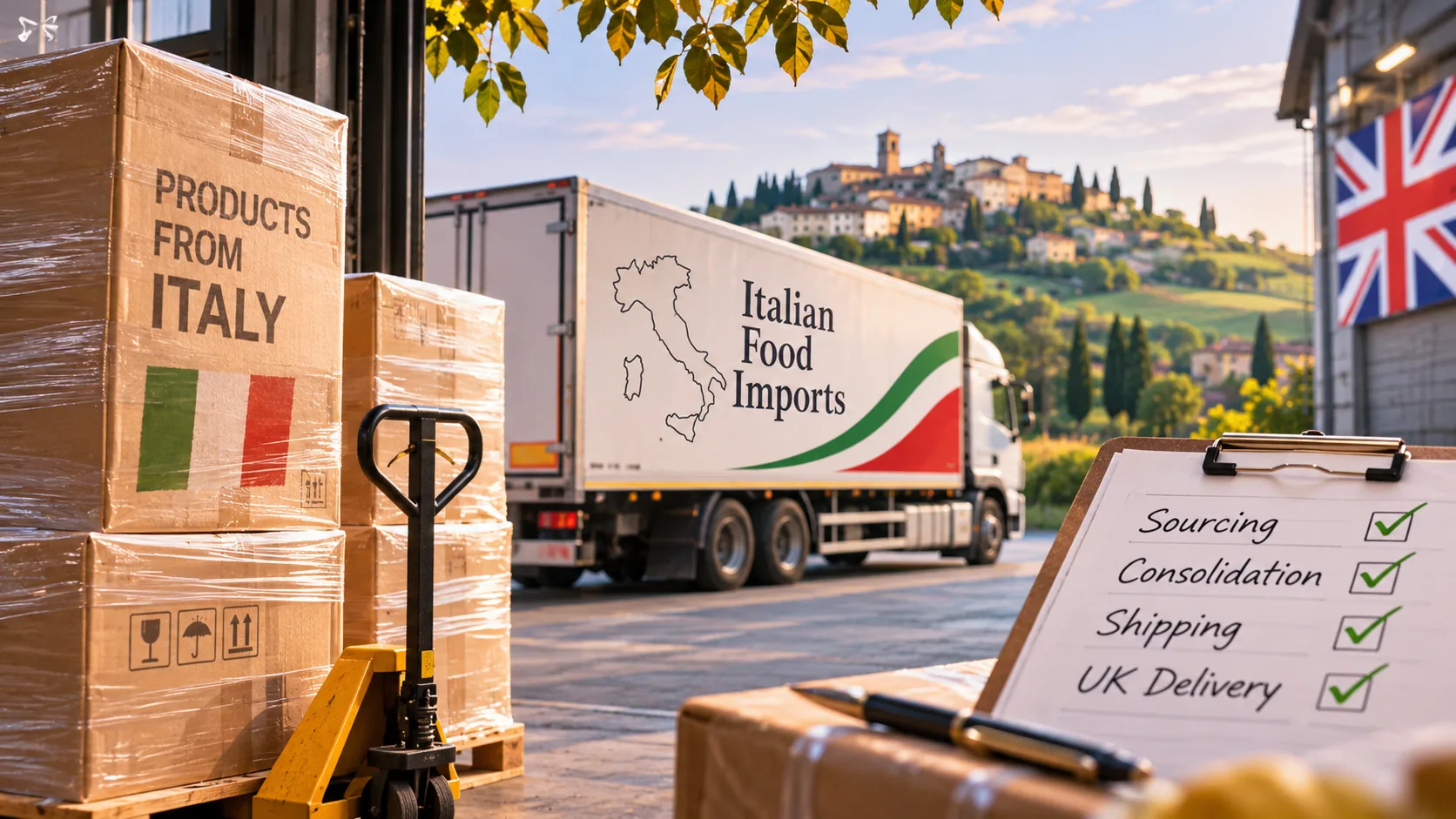
Importing Food from Italy to the UK: Is It Worth It for Your Business?
Italy is one of the world’s best-known food-producing countries, yet much of what reaches the British market comes from a relatively limited selection of manufacturers and established export brands. For UK restaurants, pizzerias, cafés, delicatessens and independent food retailers, this can create a misleading impression of the Italian food market. The products available through local wholesalers may be familiar, reliable and perfectly suitable, but they represent only part of a much wider choice.
Beyond those familiar names are countless established manufacturers, regional specialists and producers supplying the Italian domestic market, often with little or no distribution in the UK. Exploring this wider market can open up opportunities to discover different products, improve purchasing conditions and, perhaps most importantly, develop an offering that sets a business apart from its competitors. But does importing food from Italy actually make commercial sense?
The Italian food market is bigger than the brands you already know
Italy’s food industry is remarkably diverse. Alongside internationally recognised manufacturers are regional producers, specialist businesses and substantial companies whose products are widely sold in Italy but rarely seen abroad. This is particularly evident in categories such as pasta, flour, coffee, biscuits, preserves and professional food ingredients. Some producers have built an international reputation through successful export strategies and extensive distribution networks, but international recognition doesn’t necessarily reflect how a brand is perceived in its home market. In Italy, even the most recognisable names compete with a much broader selection of producers, many of which are equally established and highly regarded.
A product considered a benchmark for Italian quality in the UK may simply be one of several familiar options in Italy. Equally, a producer with limited international visibility may be a preferred choice among Italian consumers or food professionals. This isn’t necessarily a question of price, nor does it mean that lesser-known products are automatically better. Taste, regional traditions, technical characteristics and intended use all influence purchasing decisions. A pizzeria, for example, may prefer a particular mill because its flour performs better with a specific dough or fermentation method, while a café might choose a regional coffee roaster for the characteristics of its blends rather than the reputation of its brand. Access to more producers means greater freedom to select products based on what actually suits a business, rather than being restricted to what happens to be available through established UK distribution channels.
The real value of an independent business is what makes it different
For an independent restaurant, café or food retailer, competing on price alone is rarely a sustainable strategy. Larger businesses often benefit from purchasing power, distribution networks and economies of scale that smaller operators cannot easily match. What independent businesses can offer, however, is something more distinctive: a carefully developed product range, particular flavours, specialist knowledge and an experience that customers associate with that business. People return to a restaurant because they enjoy its food, choose a café because they appreciate its coffee and visit a delicatessen because they expect to discover products they cannot find everywhere else.
This is where access to a wider range of suppliers becomes commercially important. When businesses purchase from the same distributors, their offerings can become increasingly similar. Exploring the broader Italian market creates opportunities to make different choices, whether that means selecting a particular flour, introducing an unfamiliar regional speciality, finding a distinctive coffee blend or building a retail assortment around products that are not widely available in Britain. These products don’t necessarily have to be expensive, exclusive or artisanal. An established Italian manufacturer with limited UK distribution may offer exactly the combination of quality, consistency and commercial pricing that a business needs.
The value of a product isn’t measured solely by the pennies saved on its purchase price, but also by what it allows a business to offer its customers. An ingredient that costs slightly more but improves a signature dish, a coffee blend that customers particularly enjoy or a distinctive product range that encourages repeat visits may represent a better commercial decision than choosing the cheapest available alternative. Equally, discovering a competitively priced producer may allow a business to improve its offering without increasing costs. Price remains important, but it needs to be considered alongside quality, customer experience and the identity a business wants to build. The real opportunity is not simply to buy differently, but to offer something worth choosing.
Can importing Italian food actually save money?
Importing from Italy can offer financial advantages, although not for every product or every business. Italy has a competitive domestic food industry, with numerous manufacturers operating in the same categories. This can create attractive purchasing opportunities, including products of comparable quality to those already available in the UK at more favourable prices. However, the manufacturer’s selling price is only part of the calculation. International transport, customs clearance, applicable duties and other import-related expenses must all be considered when evaluating the final cost.
For widely distributed products, established UK wholesalers may already offer excellent purchasing conditions. Their volumes, logistics networks and locally held stock can make them difficult to compete with, particularly when frequent deliveries or small quantities are required. Importing becomes more interesting when the difference in product price, quality, specifications or availability is sufficient to justify the additional logistics involved. The relevant comparison is therefore between the total delivered cost and the alternatives available locally, rather than simply between Italian and British price lists. And even when the final cost is similar, importing may still be worthwhile if it provides access to a product that better suits the business or contributes something distinctive to its offering.
Mixed shipments, full pallets and smarter purchasing
One of the main challenges of importing food is making international transport economical. A small shipment containing only a few inexpensive products may be difficult to justify, while larger quantities allow transport costs to be spread across more units. Mixed orders can be particularly useful for businesses that need a variety of products without purchasing large volumes of each one. A delicatessen, for example, might want pasta, sauces, biscuits, coffee and preserved foods from several Italian suppliers. Where consolidation is possible, combining these purchases into a coordinated shipment can make more efficient use of transport capacity and reduce the cost attributable to individual products.
Full pallets of a single product can be equally attractive. A pizzeria regularly using a particular flour, or a café with consistent demand for a specific coffee blend, may benefit from purchasing larger quantities at once. The decision depends on expected consumption, purchasing conditions, available storage space and the capital tied up in stock. Many ambient food products have a relatively long shelf life when stored correctly, allowing businesses with suitable facilities to plan purchases over a longer period and reduce the frequency of international deliveries. Product value and weight also matter, since transport generally has a greater impact on inexpensive, heavy goods than on products with a higher value relative to their weight.
There is no universal rule that mixed shipments are better than full pallets, or that buying more automatically means saving money. The objective is to find a sensible balance between purchasing costs, shipping, stock levels and actual demand. For businesses able to plan their requirements, however, importing can become a practical part of their purchasing strategy rather than an occasional exception.
You don’t need to replace your existing UK wholesalers
Importing from Italy doesn’t have to mean changing the way a business purchases everything. In many cases, combining UK wholesalers with selected Italian suppliers is the most practical approach. Local distributors offer clear advantages, including shorter lead times, readily available stock and the flexibility to replenish frequently. These benefits remain particularly valuable for everyday products, unpredictable demand and businesses with limited storage capacity.
Italian suppliers can complement these arrangements by providing access to alternatives that are less widely distributed in Britain. A restaurant might continue purchasing its everyday ingredients locally while importing selected regional specialities. A pizzeria could source one particular flour from Italy while retaining its existing suppliers for other products. An independent retailer might introduce a distinctive Italian range without replacing its entire assortment. This selective approach allows businesses to benefit from a broader supplier network without creating unnecessary complexity or compromising the reliability of their existing supply chain.
PickingCherry.com: helping independent businesses offer something different
For many UK businesses, the difficulty isn’t necessarily identifying an interesting Italian product. It’s managing everything that comes afterwards. Finding reliable suppliers, communicating with different producers, coordinating purchases, arranging international transport and dealing with import procedures can quickly become time-consuming, particularly for smaller businesses without dedicated purchasing or logistics teams.
PickingCherry.com was developed to make that process more accessible. We bring together selected Italian food suppliers through a B2B marketplace while managing the purchasing and logistics process centrally. Rather than expecting each producer to operate its own international ecommerce service, we coordinate product information, orders, supplier communication and shipping arrangements. This allows UK businesses to explore a wider selection of Italian products through a single platform, without having to manage every stage of the process themselves.
But making importing easier is only part of our purpose. We believe independent businesses should have access to more than the same familiar products available to everyone else. Whether the objective is to improve a recipe, introduce a new product range, find a different producer or develop a more recognisable identity, better sourcing choices can create value far beyond a small difference in purchasing price. Our role is to help businesses discover and access those opportunities, while keeping the practicalities of buying from Italy manageable.
Our online catalogue offers a growing selection of ambient Italian food products from different suppliers. If you’re looking for a particular product, a different specification or an alternative producer that isn’t currently listed, you can also contact us. We’ll explore the available sourcing options and consider whether the quantities, costs and logistics make commercial sense for your business.
Is importing food from Italy worth it?
For many businesses, it can be, but the answer depends on what they need and what they’re trying to achieve. Sometimes the advantage is a lower final purchasing cost; sometimes it’s better technical performance, a particular flavour or access to products that aren’t readily available in the UK. Importing doesn’t have to replace existing suppliers, and it certainly doesn’t have to involve every product a business purchases.
What matters is recognising that the Italian food market offers considerably more choice than the selection most British buyers regularly encounter. That wider choice can help independent businesses develop an offering that reflects their own standards, preferences and ambitions rather than simply following what is already available.
Ultimately, the value of what you buy isn’t just what you pay for it, but what it allows your business to offer. A few carefully chosen products can make a meaningful difference to the experience customers have, the reasons they return and the identity they associate with a business.
At PickingCherry.com, that’s what we want to make possible: giving UK food businesses access to a broader Italian market and helping them turn better sourcing choices into something of real value.
Explore our Italian food catalogue or get in touch to discuss what you’re looking for.
 £
 €